


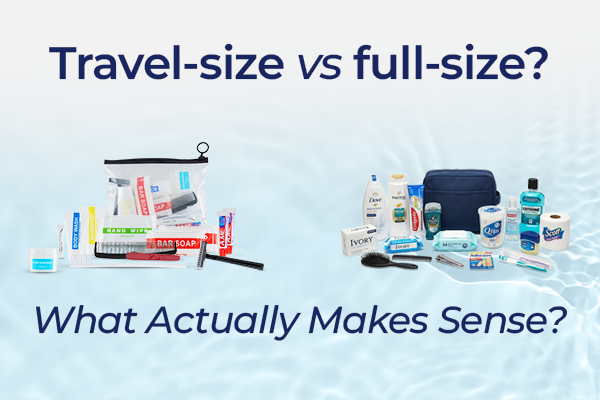
The short answer: Neither is universally better. Travel-size products are built for portability and high-volume handouts. Full-size products deliver more value per ounce when recipients have somewhere stable to keep them. The right choice depends entirely on your program, your recipient, and your logistics.
What's the Difference Between Travel-Size and Full-Size Hygiene Products?
Travel-size hygiene products are typically under 3 oz (100 ml) — think small shampoo bottles, travel toothpaste, and mini deodorant sticks. They're designed for portability and short-term use, lasting days rather than weeks.
Full-size products are standard retail units — the same sizes found on drugstore shelves. They cost less per ounce, last significantly longer, and deliver more product value when someone has a stable place to keep them.
Neither format is a shortcut to the other. They serve different distribution models, different recipients, and different program goals.
When to Use Travel-Size Hygiene Products
Use travel-size hygiene products when the kit needs to move and the recipient might too.
Travel-size is the right call when:
-
You're running street outreach, pop-up events, or one-time handouts
-
Recipients are mobile and may not have a permanent space to store items
-
You're assembling kits at high volume with volunteers (drop-in packing, no decanting)
-
You need to keep shipping and storage costs low across large case quantities
-
Distribution is a single encounter with no follow-up contact planned
The tradeoff: Travel-size costs more per ounce. You're paying for the compact format, not just the product. If your recipients have somewhere stable to land, that premium stops making sense.
When to Use Full-Size Hygiene Products
Use full-size hygiene products when the recipient has somewhere to put them.
Full-size is the right call when:
-
Recipients are shelter residents with a locker, bed, or assigned space
-
Your program has a longer time horizon — case management, transitional housing, or regular follow-up
-
You want to maximize product value per dollar spent on procurement
-
Loss or abandonment risk is low because the recipient is settled (at least temporarily)
-
You want the kit to feel more substantial and dignified as a resource
The tradeoff: Full-size products are heavier to ship, bulkier to store, and slower to handle during assembly. Plan your warehouse space and volunteer capacity before committing to a large full-size buy.
Travel-Size vs. Full-Size: Side-by-Side Comparison
|
Factor |
Travel-Size (Under 3 oz) |
Full-Size (Retail Unit) |
|
Portability |
Pocket-ready, built for foot traffic |
Heavier — but substantial once the recipient is settled |
|
Value & Longevity |
Days of use; higher cost per oz |
Weeks of use; lower cost per oz |
|
Shipping & Storage |
Lightweight cases, lower freight costs |
Adds weight and shelf space — plan before buying |
|
Assembly Speed |
Fast drop-in packing, no decanting |
Simple to pack — just bulkier to handle and box |
|
Best For |
Street outreach, events, one-time encounters |
Shelter residents and longer-stay recipients |
Source: Product Size Decision Grid — Wholesale Sock Deals
How to Choose: Two Questions That Make the Decision Simple
Before placing any bulk hygiene order, answer these two questions:
1. Does the recipient have somewhere stable to keep this product?
-
Yes → full-size
-
No, or unknown → travel-size
2. Is this a one-time encounter or an ongoing program relationship?
-
One-time → travel-size
-
Ongoing → full-size delivers more value over time
If you can answer both questions clearly, the right format almost always becomes obvious. The mistake most programs make is defaulting to one format without checking these two variables first.
Can You Use Both? Yes — Here's How
Some programs run a hybrid approach intentionally. A common model:
-
Travel-size "go bag" given at the point of first contact — street outreach, intake, or a community event
-
Full-size follow-up kit delivered later to a shelter, transitional housing unit, or case manager
This works well when your program has multiple touchpoints with the same recipient. The key is being intentional. Mixing formats without a clear reason creates inconsistency in your kits and confusion in your supply chain.
Common Mistakes to Avoid
Defaulting to travel-size because it's easier to buy in bulk. Bulk availability isn't a good reason to use the wrong format. If your recipients have a stable place to keep a product, full-size delivers better value — and your procurement budget goes further.
Defaulting to full-size because it "feels more generous." A 12 oz shampoo bottle is worthless to someone who can't carry it. Generosity means matching the product to the recipient's actual situation.
Mixing formats without a plan. If half your kits are travel-size and half are full-size with no documented reason why, your volunteers and logistics team will struggle to maintain consistency at scale.
Bottom Line
Travel-size and full-size hygiene products aren't competing — they're purpose-built for different programs. The right format is determined by your recipient's situation and your distribution model, not by price, convenience, or habit.
-
Travel-size: mobile recipients, single encounters, high-volume outreach, street teams
-
Full-size: settled recipients, shelter stays, longer-term programs, better per-ounce value
Know your recipient. Match the format to their reality.
Download the Free Decision Grid